

Description
Do you have a tough project ahead of you? Consider, thousands of years ago, that the Pharaohs built the pyramids. Quite an initiative! But the construction could have been executed better, later, because we, as a species, thrive on improvement: There has never been a significant period of time where we didn’t strive to make our mark with huge changes: The Hoover Dam, for example, was the first initiative of such scope to be managed using the Waterfall delivery framework first introduced by Henry Gantt in 1922. When PMs think of Waterfall delivery, we think of Gantt Charts, and vice versa. The overlap of tasks expected with Waterfall delivery and Gantt Charts, however, would come to be managed more efficiently later with Agile projects.

Agile is project management’s answer to the question “What would happen if we could parcel out our project risk into sprints?” which are just smaller, logical divisions of the work to be done until our output is ready to become an input to something else. But how are these divisions… um, divided? Well, that depends on which Agile framework we’re working with, or some may still be bound by Waterfall projects, and that’s okay. Waterfall is typically the first choice for project teams when extensive documentation or early and often checkpoints are required, since Agile is heavy on coding, lighter on documentation. For this reason, the accepted setup for Agile should always include Pair Programming, or Tandem Coding. It’s the organization’s truck insurance.
So what are some Agile frameworks, then?
Most of us are at least somewhat familiar with Scrum, where–for the subject matter experts actually delivering the output–we keep our eye on the ball with daily stand-up Scrums that basically limit focus to yesterday, today and tomorrow, implements kaizen (continuous improvement) and is best relied upon when sequential improved versions of an output are required.
Another popular methodology is Lean, which is conceptually about eliminating every kind of waste we can, whether tangible or intangible.
Next is XP, or Extreme Programming, which is known for its disciplined engineering practices, short development cycles and five core values: communication, simplicity, feedback, courage and respect.
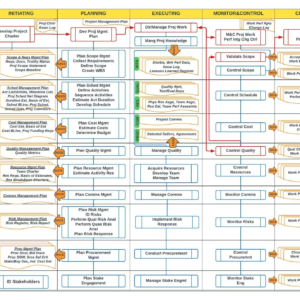
Finally, of the widely used Agile methodologies, there’s always Kanban, which you can think of as cards with tasks and/or outputs written on them, pinned to a board, and they gradually move through each column: From Initiating to Planning to Executing and Monitoring and Controlling to Closing. One interesting aspect of Kanban is that the sprint lengths are untimed, as opposed to with most other types of Agile. Kanban expects you to take your time and get it right.
Project management is a field where it can take decades or centuries to update its own best practices. Yes, there have been many innovations over the millennia, but only occasionally have any such innovations updated the Project Management Institute’s official Project Management Book of Knowledge (PMBOK®). I earned my PMP® credential with the 5th Edition, 18 years ago, whereas the 7th Edition is the version currently used globally, so I have recently devoted a large number of PDUs (professional development units) to studying all that has been updated, and to refreshing my familiarity on all that has not been updated. That’s 18 years of being continuously credentialled as a PMP® in good standing.
Reviews
There are no reviews yet.